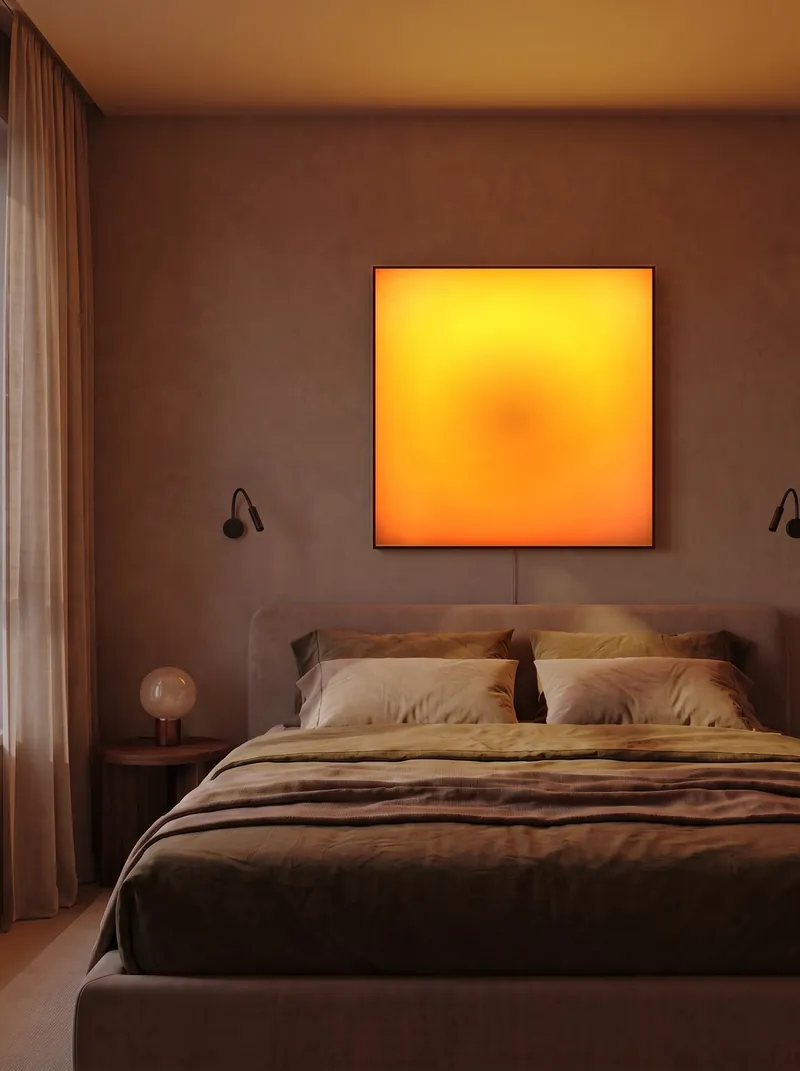
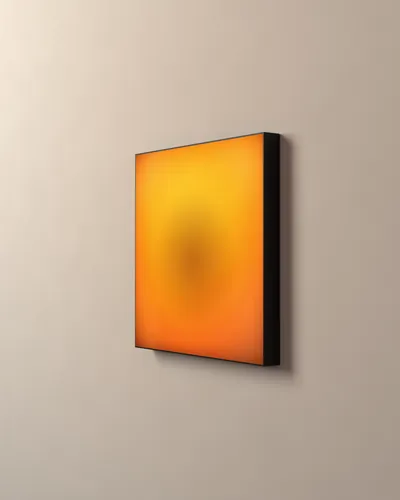
 Light painting
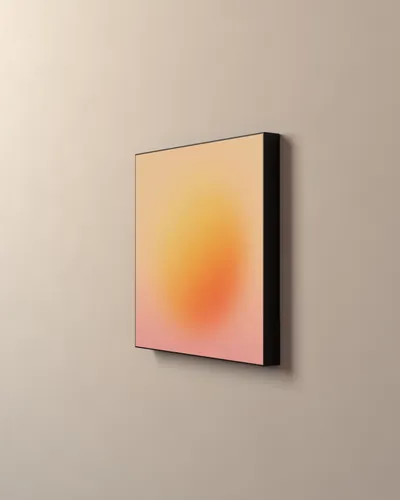 Light painting
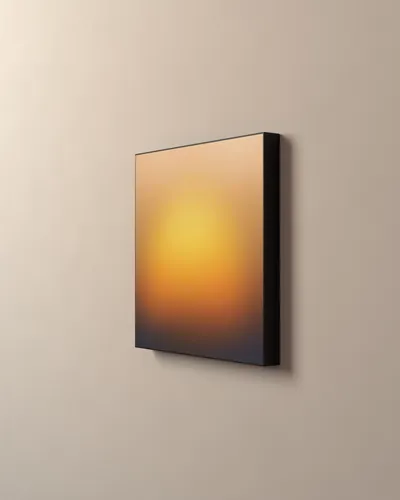 Light painting
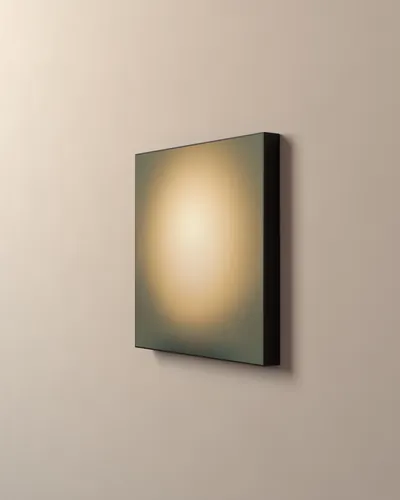 Light painting
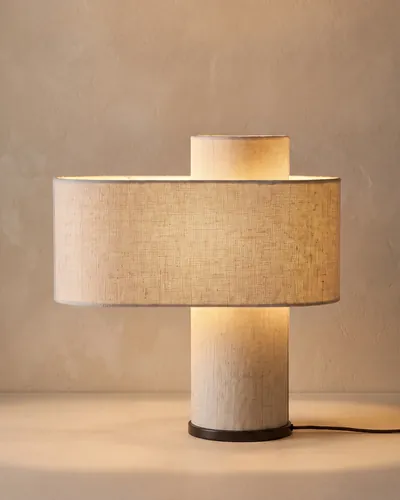 Fabric table lamp
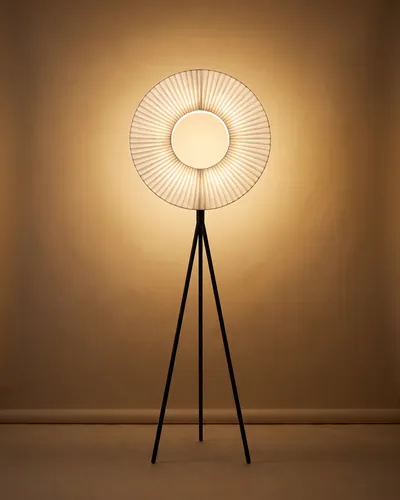 Floor lamp
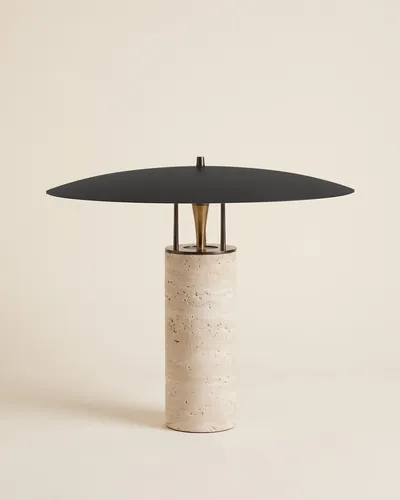 Travertine table lamp
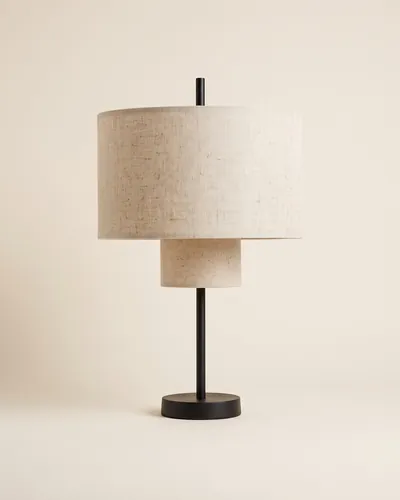 Linen table lamp
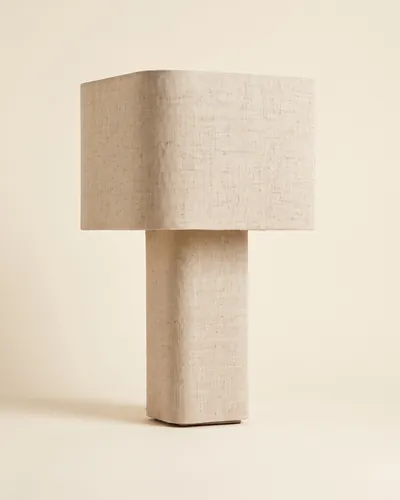 Fabric table lamp
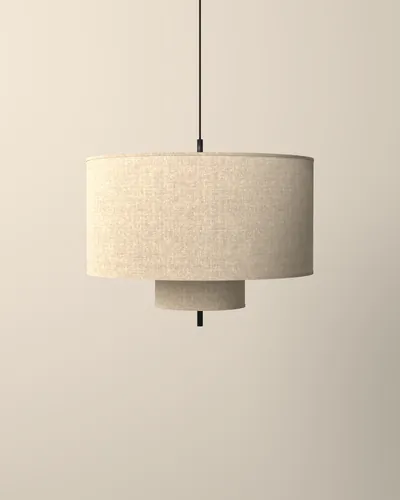 Fabric pendant light

Before thinking about format or colour, think about the moment you will look at it. A light painting comes alive mainly in the evening: that is when it shows its full measure. The right place is therefore the one you see from where you sit.
Choosing the wall
Most often, it is the wall facing the sofa, the one above the headboard, or the first one you see as you come in. A light wall — off-white, limewash, linen, stone — reflects the halo and extends the light well beyond the frame. A darker wall concentrates it and gives a more intimate, almost gallery-like effect.
Prefer an uncluttered wall, with no other frame close by: the piece needs space around it for its halo to take shape.
The right height
The gallery rule is a good starting point: the centre of the painting about 1.50 m from the floor, at eye level. Above a piece of furniture, the furniture decides: leave 20 to 30 cm between its top and the bottom of the frame, so that the two answer each other without touching.
The right place is the one you see from where you sit.
The right format
Above a piece of furniture, centre the piece and give it some air:
- above a sofa, the 80 format gives the wall its presence;
- above a 160 cm bed, the 80 format naturally finds its place;
- in an entrance hall, a study or on a narrow wall, the 55 format is enough to change the atmosphere.
Our format guide shows them to scale, above a sofa.
Fixing it to the wall
Our pieces have two keyhole brackets fixed on the back, and their box contains two screws with their wall plugs. A light painting hangs like a heavy frame: on two screws set apart, perfectly level. If your wall needs other plugs, the reference we recommend: Fischer DuoPower 6 × 30 universal plugs, sold with their screws. They go in with a 6 mm drill bit and hold in plaster, plasterboard, brick and concrete alike. For the 80 format (5.6 kg), plan on two people.
Without drilling the wall
If you rent, or would rather leave a wall untouched, there are several solutions, from the simplest to the most discreet.
- Set on a console, a chest of drawers or a mantelpiece, leaning against the wall: no holes, and the look of a gallery. On the Essential version, the dimmer knob sits under the frame: slip two small cork pads under the corners, slightly thicker than the knob, and choose the cable exit at the bottom.
- Hung from a picture rail, if your wall already has one, as is often the case in older buildings: two picture-rail hooks and two steel wires, and no holes either.
- On plasterboard, two 3M CLAW hooks, 11 kg model, push in by hand, without tools. They leave only small holes that are easy to fill.
- On an old plaster wall, X-shaped picture hooks, tapped in with their fine nails, leave holes just as discreet.
We advise against adhesive strips: they are not designed for a piece of this weight connected to a cable.
What about the cable?
It is the detail that makes the difference between a correct installation and a perfect one. Ideally: a socket installed behind the painting by an electrician, invisible once the piece is hung. Otherwise, a thin trunking painted the colour of the wall guides the cable to the skirting board and is soon forgotten.
Let the light breathe
A table lamp beside it, an object on the furniture, and that is all. The less there is around it, the more the light takes up the space. In the evening, switch off the ceiling light and let the painting set the tone of the room. Our advice on composing with evening light.
Unsure about your wall? Send us a photo with its width and that of the furniture below it: we will reply with a recommendation of format and height.
Ask for advice